Temple of Zeus
TicketLens lets you:
Search multiple websites at onceand find the best offers.
Find tickets, last minuteon many sites, with one search.
Book at the lowest price!Save time & money by comparing rates.
The Temple of Olympian Zeus (Naós tou Olympíou Diós, Ναός του Ολυμπίου Διός, or the Olympieion) is a ruined temple in the heart of Athens. It was built in the 6th century BCE but only finished under Roman rule in the 2nd century CE. With 104 colossal columns, it was the largest temple in Greece. Visit the site to see the handful of columns still standing, or buy a combo ticket to get access to the temple, the Acropolis, and several other archaeological sites in Athens.
Select a date to find available tickets, tours & activities:
Tickets & Tours
Discover tickets and tours for the Temple of Olympian Zeus in Athens.Athens: Temple of Olympian Zeus Ticket and Audio Tour
3.5(228)
Go to offer
Athens Half Day Tour, Acropolis, Parthenon, Temple of Olympian Zeus & Hephaistus
4.8(671)
viator.com
Go to offer
Private Mythology Tour of the Acropolis and Acropolis Museum
5.0(39)
viator.com
Go to offer
Acropolis, Temple Of Zeus,Olympic Stadium,Parliament,Guards Athens private Tour
4.8(11)
viator.com
Go to offer
See all Tickets & Tours
4 tips for visiting the Temple of Zeus
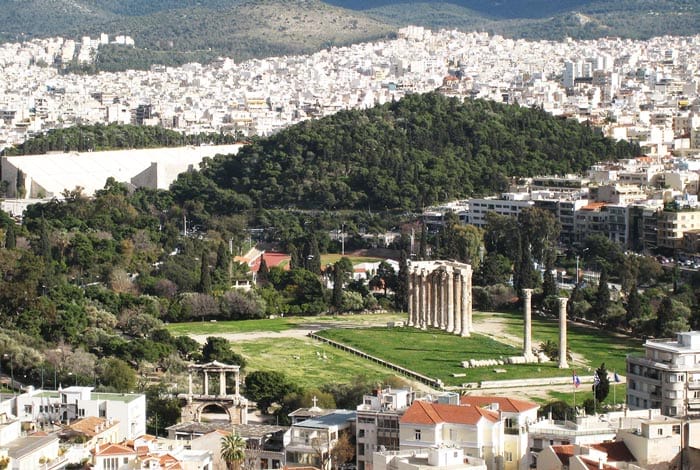 Overview of Temple of Zeus | Flickr: Titanas CC BY-SA 2.0
1
Take a Guided Tour to Discover the Site
While the Temple of Olympian Zeus is impressive, it’s not the best-preserved archaeological site in Athens. Visit with an expert guide who’ll be able to fill in the gaps and tell you the story that surrounds the temple.
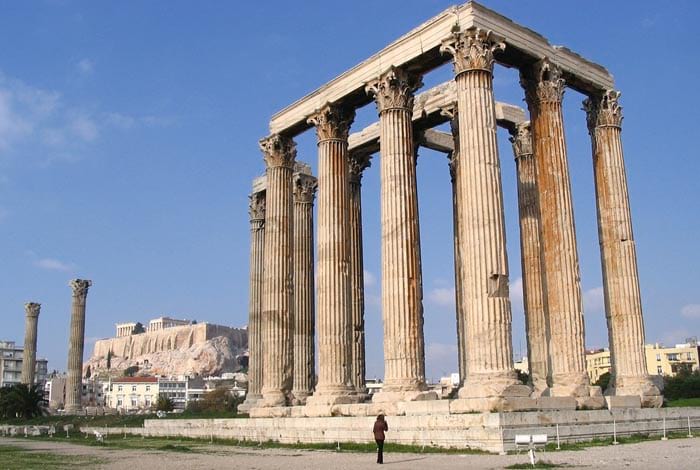 Acropolis from the Temple of Zeus | Flickr: cgrand CC BY-SA 2.0
2
Get the Perfect Angle for the Gram
If you walk to the far side of the temple, there’s a chance you can line up a great photo with the Acropolis in the background. Take your time and let other tourists pass you by - your ticket lets you spend as much time as you want in the grounds.
3
Get a Combo Ticket and See the Acropolis As Well
A special package ticket is available that combines the archaeological sites of Acropolis, the North & South slopes of the Acropolis, the Ancient Agora, Hadrian’s Library, the Roman Agora, Kerameikos, the Olympieion (where you’ll find the Temple of Olympian Zeus), and the Gymnasium of Lykeion. The combo ticket is the best value for money in summer as the entry fees to several of the sites are heavily discounted in winter.
4
Arrive Early to Avoid the Summer Heat
Temperatures in Athens can soar in the summer months, and the site doesn’t contain much shade. Arrive early in the morning or come prepared with sunscreen, hats, and sunglasses to make sure you don’t get sunstroke.
Frequently Asked Questions
What is the Temple of Zeus?
The Temple of Olympian Zeus stands at the foot of the Acropolis, its 14 surviving columns towering a huge 55.5 feet (17 meters) high. It was the largest temple in Ancient Greece, but its story is long and complicated. Building began around 550 BCE on the site of another ancient sanctuary dedicated to the Greek god Zeus but stopped when Hippias, son of the Athenian tyrant Peisistratos, was expelled in 510 BCE. The story goes that the Athenians decided not to complete the temple as a building of that scale was hubristic, an offense against the gods. That didn’t worry Antiochus IV, who believed he was an avatar of Zeus and ordered the work to restart. He changed the design so that it reached the scale of the ruins we can see today, but construction stopped again when the temple was only half-finished. After the rise of the Roman Empire, Emperor Hadrian visited Athens and authorized a building project that included the completion of the Temple of Zeus. It was completed and dedicated to the god by Hadrian in 132 CE, and contained a huge statue of Zeus made of gold and ivory. Unfortunately, the finished temple didn’t survive for long - it was badly damaged in 267 when the Herules sacked the city and in 425 the worship of Greek and Roman gods was banned by Theodosius II, a Christian emperor. Material was taken from the temple to be used in other buildings, including a Christian basilica, and by 1436 only 21 of the original columns were still standing. The temple was first properly excavated in 1889 by Francis Penrose and today it is protected by the Greek government.
Read more.Can we go inside the temple?
The temple doesn’t really have enough walls or columns left for there to be an ‘inside’! However, the archaeological sites in Athens are relatively fragile after years of weathering, so visitors are asked not to climb on or touch the ruins. Security staff can be very strict in enforcing this rule, so be sure to respect it.
Read more.How long does it take to visit the temple?
Not long! It takes less than half an hour to walk around the site unless you’re a photographer who wants to set up the perfect shot. A guided tour might take slightly longer, with guides filling you in on the history of Ancient Athens. If you’re combining your visit with a trip to the Acropolis or any of the other archaeological sites included in the combo ticket, then you should plan to spend at least half a day exploring.
Read more.What else is there to do nearby?
The Temple of Olympian Zeus is in the heart of Athens, surrounded by several of the most important archaeological sites in the city. The closest of these to look out for is Hadrian’s Arch, but it’s also just across the road from the path that leads up the slopes of the Acropolis (past the Theater of Dionysus and the Odeon of Herodes Atticus) to the Parthenon and Erechtheion. On your way, you’ll also pass the Acropolis Museum, where you can visit several of the Parthenon marbles (the remainder being housed in the British Museum in London). If you’d rather walk away from the Acropolis, you’re sure to stumble on the Panathenaic Stadium and the National Garden. The National Garden is a particularly nice place to find some shade and take a break from exploring the city.
Read more.General information
opening hours
The temple is part of the Ancient Olympia archaeological site and has no separate opening schedule. The site is open daily: April 1–August 31 from 8:00 am to 8:00 pm; September 1–15 from 8:00 am to 7:30 pm; September 16–30 from 8:00 am to 7:00 pm; October 1–15 from 8:00 am to 6:30 pm; October 16–31 from 8:00 am to 6:00 pm; and November 1–March 31 from 8:30 am to 3:30 pm. Last admission is 20 minutes before closing. It is closed January 1, March 25, May 1, Greek Orthodox Easter Sunday, and December 25 and 26; exceptional changes may apply.
address
Temple of Olympian Zeus
Athens 105 57
Greece
Athens 105 57
Greece
tickets
The temple has no separate ticket. Access is included in the Ancient Olympia ticket: €20 full price or €10 reduced, also covering the Archaeological Museum of Olympia and the Museum of the History of the Olympic Games. Admission is free for visitors from EU countries aged 25 and under and from non-EU countries aged 18 and under; visitors over 65 from Greece or another EU country receive 50% off from October 1 through May 31. Free-admission dates include March 6, April 18, May 18, the last weekend of September, October 28, and the first and third Sundays of each month from November 1 through March 31. On these dates, tickets are issued only at the ticket offices. Bring original proof of eligibility.
how to get there
It’s easy to reach the temple by public transport. You can take tram lines T4 or T5 to Zappeio, bus numbers 165, 227, 790, or 856 to Makrygiannē, or trolleybus numbers 2, 4, or 11 to ΑΓ.ΦΩΤΕΙΝΗ. The closest metro station is Acropoli, which is served by line 2 of the Athens metro.
How useful was this page?
Average rating 5 / 5. Vote count: 4.
Compare prices for more top sights in Athens:
Ancient Agora of Athens18 tickets & guided tours
National Archaeological Museum13 tickets & guided tours
Benaki Museum1 tickets & guided tours
Museum of Cycladic Art3 tickets & guided tours
Epidavros Ancient Theater100 tickets & guided tours
Meteora206 tickets & guided tours
Popular attractions
Guinness Storehouse ticketsBelém Tower ticketsLandmannalaugar ticketsWawel Castle ticketsStratosphere Tower ticketsEtihad Towers Observation Deck ticketsLondon Bridge ticketsNew York Aquarium ticketsPère Lachaise Cemetery ticketsOne World Trade Center ticketsEiffel Tower ticketsBurj Khalifa ticketsMilan Cathedral ticketsLast Supper - Santa Maria delle Grazie ticketsMoulin Rouge ticketsGardens by the Bay ticketsDisneyland Paris ticketsDohány Street Synagogue ticketsHarry Potter: Warner Bros Studios tickets
Language
English
Currency© 2020-2026 TicketLens GmbH. All rights reserved. Made with love in Vienna.