Eiffel Tower
TicketLens lets you:
Search multiple websites at onceand find the best offers.
Find tickets, last minuteon many sites, with one search.
Book at the lowest price!Save time & money by comparing rates.
The Eiffel Tower is the landmark of Paris, the city of love. You can visit three different floors of the tower: the 1st and the 2nd floor plus the top of the Eiffel Tower. The top of the tower offers the best panoramic view over Paris. The tickets take you to different floors at the Eiffel Tower! Additionally, tours are offered. To visit the tower without having to queue, we recommend you book your ideal time slot online in advance. By Jessica Donev
By Jessica DonevSelect a date to find available tickets, tours & activities:
Eiffel Tower ticket availability
Compare ticket availability for the Eiffel Tower from the official site and other ticket reseller websites. Discover alternative options if the official site is sold out!
Date
Official site: Top
Official site: 2nd floor
Alternative options
October
Mon
26
-
-
39€
Tue
27
37€
24€
37€
Wed
28
-
-
39€
Thu
29
37€
24€
37€
Fri
30
-
-
39€
Sat
31
37€
24€
37€
November
Sun
1
-
-
39€
Mon
2
-
-
39€
Tue
3
37€
24€
37€
Wed
4
37€
24€
37€
Thu
5
-
-
39€
Fri
6
-
-
39€
Sat
7
-
-
39€
Sun
8
-
-
39€
Mon
9
-
-
39€
Tue
10
-
-
39€
Wed
11
-
-
39€
Thu
12
-
-
39€
Fri
13
-
-
39€
Sat
14
-
-
39€
Sun
15
-
-
39€
Mon
16
-
-
39€
Tue
17
-
-
39€
Wed
18
-
-
39€
Thu
19
-
-
39€
Fri
20
-
-
39€
Sat
21
-
-
39€
Sun
22
-
-
39€
Mon
23
-
-
39€
Tue
24
-
-
39€
Wed
25
-
-
39€
Thu
26
-
-
39€
Fri
27
-
-
39€
Sat
28
-
-
39€
Sun
29
-
-
39€
Mon
30
-
-
39€
December
Tue
1
-
-
39€
Wed
2
-
-
39€
Thu
3
-
-
39€
Fri
4
-
-
39€
Sat
5
-
-
39€
Sun
6
-
-
39€
Mon
7
-
-
39€
Tue
8
-
-
39€
Wed
9
-
-
39€
Thu
10
-
-
39€
Fri
11
-
-
39€
Sat
12
-
-
39€
Sun
13
-
-
39€
Mon
14
-
-
39€
Tue
15
-
-
39€
Wed
16
-
-
39€
Thu
17
-
-
39€
Fri
18
-
-
39€
Sat
19
-
-
39€
Sun
20
-
-
39€
Mon
21
-
-
39€
Tue
22
-
-
39€
Wed
23
-
-
39€
Thu
24
-
-
39€
Tickets for the Top
Experience the best view of Paris from the top of the Eiffel Tower. These tickets are only available for booking in advance.Eiffel Tower Dedicated Reserved Summit Access by Elevator
4.5(10711)
headout.com
Go to offer
Eiffel Tower Reserved Access Summit or 2nd Floor
4.4(1679)
getyourguide.com
Go to offer
Paris: Eiffel Tower Guided Tour with Summit Access
4.5(884)
Go to offer
Eiffel Tower: Reserved Access to the Summit + Small Group Tour
4.8(462)
tiqets.com
Go to offer
First & Second Floor
The viewing platforms on the 1st and 2nd floor can be reached by the stairs or by the elevator.Eiffel Tower Dedicated Reserved Summit Access by Elevator
4.5(10711)
headout.com
Go to offer
Eiffel Tower Reserved Access by Elevator and Seine Cruise
4.6(7893)
Go to offer
Eiffel Tower Summit or 2nd Floor Guided Tour
4.6(1481)
getyourguide.com
Go to offer
Eiffel Tower: 2nd floor by lift
Eiffel Tower
Official sitetoureiffel.paris
Go to offer
Fine Dining at the Eiffel Tower
A unique experience - dine exquisitely at the Eiffel Tower.Eiffel Tower: 2nd Floor by lift + glass of champagne
Eiffel Tower
Official sitetoureiffel.paris
Go to offer
Dinner at Eiffel Tower's Madame Brasserie
4.4(2252)
headout.com
Go to offer
Lunch at Eiffel Tower's Madame Brasserie
4.5(1085)
headout.com
Go to offer
Paris: Sophisticated dining with Drinks at the Eiffel Tower
4.5(1842)
getyourguide.com
Go to offer
Eiffel Tower & Seine Cruise
Combine your visit to the Eiffel Tower with a Seine cruiseEiffel Tower Reserved Access by Elevator and Seine Cruise
4.6(7893)
Go to offer
Eiffel Tower Summit or 2nd Floor Guided Tour
4.6(1481)
getyourguide.com
Go to offer
Combo: Seine Dinner Cruise, Eiffel Tower Ascent & Moulin Rouge Show Tickets
4.5(1717)
headout.com
Go to offer
Eiffel Tower Tickets with City Tour & Seine River Cruise
4.4(6959)
headout.com
Go to offer
See all Eiffel Tower & Seine Cruise
More Tickets & Tours
Discover even more offers around the most famous attraction in Paris.Paris: Private Photoshoot Near Eiffel Tower 55 Photos
4.9(235)
getyourguide.com
Go to offer
Highlights of Paris Bike Tour in English or Dutch
4.7(189)
getyourguide.com
Go to offer
Eiffel Tower Paris: Official guided tour in virtual reality
4.9(168)
getyourguide.com
Go to offer
Paris: Eiffel Tower and Notre Dame Night Tour by E-Bike
4.9(16)
getyourguide.com
Go to offer
See all More Tickets & Tours
8 tips for visiting the Eiffel Tower
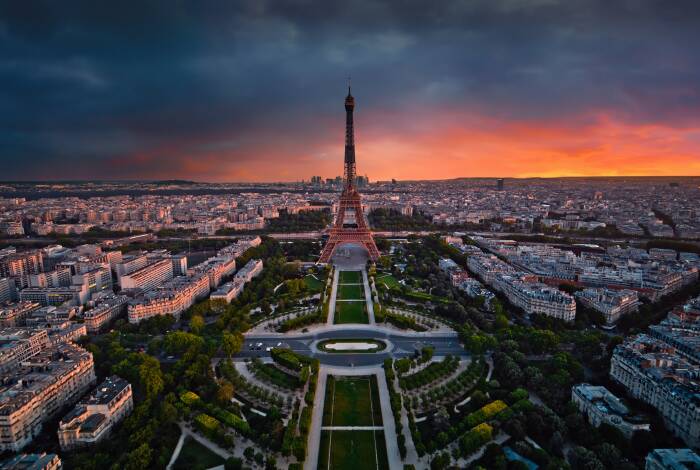 View of the Eiffel Tower | Photo: Unsplash, Timelab
1
Don't feel like standing in line? Book your ticket online here at TicketLens!
During peak season, the waiting times at the ticket counters can be up to two hours. Tickets purchased in advance are provided with a time slot during which the ticket can be redeemed. This way, you save yourself from standing in line! Regardless of the season, the Eiffel Tower is a perennial favorite, meaning tickets sell out very fast. Book your ticket at least two to three weeks in advance!
ATTENTION: Often, online tickets for a specific day are no longer available directly on the Eiffel Tower's website. That's exactly why TicketLens exists! Check out our website and find available capacities through our ticket providers! This way, you can still get your preferred ticket for your desired date!
ATTENTION: Often, online tickets for a specific day are no longer available directly on the Eiffel Tower's website. That's exactly why TicketLens exists! Check out our website and find available capacities through our ticket providers! This way, you can still get your preferred ticket for your desired date!
 View | Photo: Unsplash, Chris Karidis
2
Consider security checks - be on time
Before you can climb the Eiffel Tower, security checks are performed. To be able to adhere to your timeslot, you should be on site about 15 to 20 minutes earlier.
3
Pay attention to the flags
The area at the blue flag on the South pillar is for visitors taking the stairs to the second floor or the stairs plus elevator to the summit. Follow it to the stair entrance; from September 29, 2026, stair tickets must be reserved in advance. The green flags at the East and West pillars mark access for ticket holders taking the elevator.
4
Reserve a table in one of the restaurants - no more queues!
If you want to avoid the queues and dine comfortably or finely on one of the floors, then reserve a table in one of the restaurants and spare yourself the wait. This way, you gain access to the separate entrance that takes you to your desired floor. Further down on our website, you can find more information about the restaurants at the Eiffel Tower!
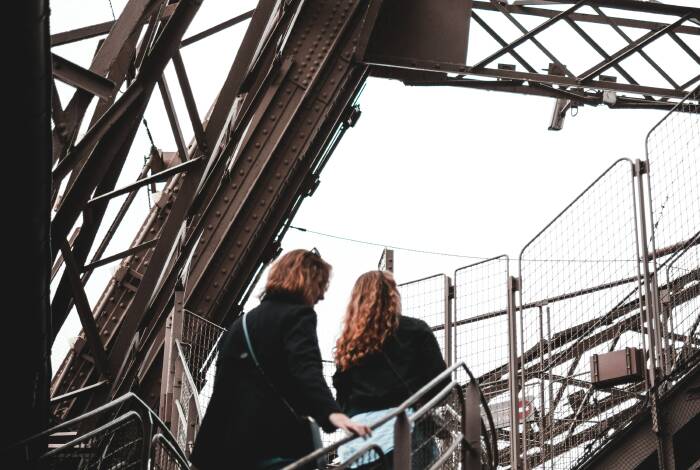 The staircase leading up to the 2nd floor of the Eiffel Tower | Photo: Unsplash, Karl Hedin
5
Take your time at the Eiffel Tower
If you want to enjoy the Eiffel Tower in peace, you should plan at least an hour and a half to visit the top. If you want to climb all the floors of the tower, you will need about two and a half hours. This already takes into account the waiting times at the elevators and the time you will need to explore the building! Continue reading - you will find the most important information about the individual floors in the next section here on our website.
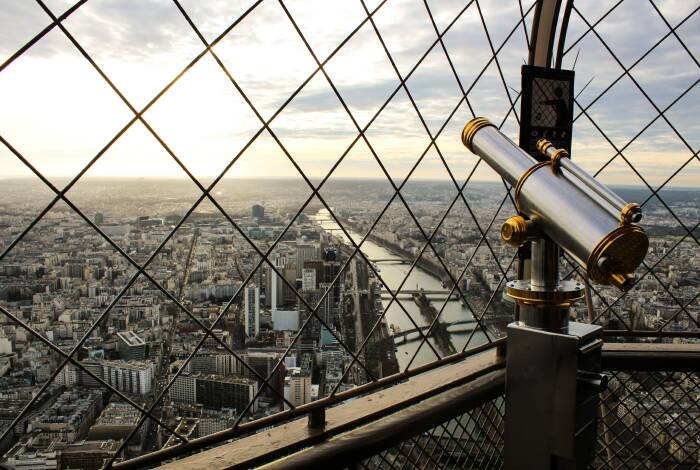 Each floor offers a unique view over Paris | Photo: Unsplash, Sam Williams
6
Use the staircase
Since the queue for the elevators can be especially long, you can also use the stairs that lead up to the second floor. While climbing a total of 745 steps, you can admire the construction of the Eiffel Tower from up close. It takes approximately 15 to 20 minutes to ascend each floor.
7
Visit all floors - not every ticket takes you everywhere!
It is best to book the ticket that allows you access to all floors and especially to the top. At the top, Gustave Eiffel, his daughter, and Thomas Edison await you - of course, they are only wax figures standing in the accurately reconstructed room, but they are still worth a visit! You should also visit the other floors, each offering its own view. For visitors who are not afraid of heights: there is a glass base on the 1st floor, from which you can look through at a hight of 58m (190.29 ft)!
8
Use the online guide
At the Eiffel Tower it is possible for you to connect with the Online Guide on your smartphone to receive additional historical information during your visit. On-site, you can connect to the free WLAN access _WiFi_Tour_Eiffel. The online guide is available in French, English, Spanish, and Chinese. Also, at the ticket counter and the elevators, brochures with basic information are available in French, English, Spanish, and German.
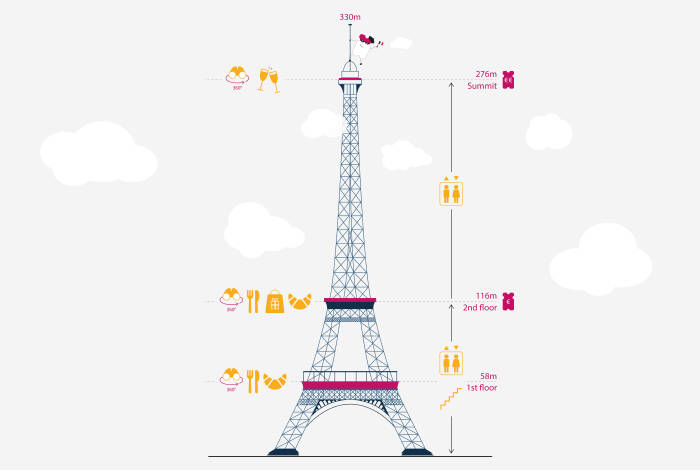
The offers of the floors
Once, visitors of the Eiffel Tower could use the stairs to reach the top. Today, the staircase only goes up to the second floor, from where an elevator takes you to the top. Then as now, you can enjoy breathtaking views of the city of love and wonderful food and drinks at the Eiffel Tower.
Taking the elevator to the top
Already in the time of the opening of the Eiffel Tower, visitors could use elevators - what is commonplace today, was something special back then. Meanwhile, only two of the original elevators are still in operation and transport guests to the top. Due to the different ascent options, both by foot and by elevator, tickets are offered at different prices. The ascent from the second floor to the top is only possible by elevator!
Climbing the Eiffel Tower on foot
Back then, 1,585 steps led to the top and a total of 1,710 steps beyond the top via a spiral staircase! Today, the spiral staircase in its original form no longer exists; it was cut into 24 pieces. Some of these parts were auctioned off, with one piece even fetching a record 275,000 euros in 2020. On the first floor of the Eiffel Tower, remnants of the former spiral staircase can still be admired. Today, 364 steps lead to the first floor and an additional 381 steps to the second floor. The second floor of the Eiffel Tower was recently a destination for athlete Anouk Garnier in the spring of 2024. She broke the world record for rope climbing on the Eiffel Tower. She is an obstacle course athlete who managed to climb 110m (360.89 ft) up a rope to the second floor of the Eiffel Tower. The previous world record for climbing a rope suspended vertically was 90m (295.28 ft), while for women it was only 26m (85.3 ft). Garnier took only 18 minutes to climb the famous landmark.
Culinary delights at an altitude
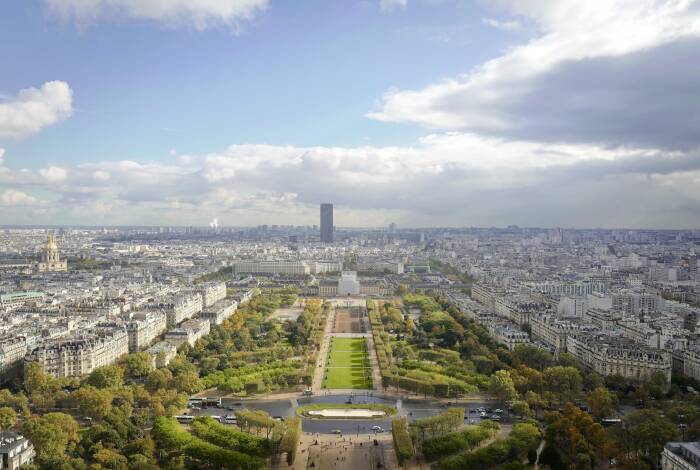
On the 1st and 2nd floor, there are small food stands offering snacks such as pizza, paninis, and hotdogs for a quick bite in addition to warm beverages like tea and coffee. If you desire a more exclusive ambiance, you can find the Michelin-star awarded restaurant Jules Verne on the second floor, where creative French cuisine is served with a view of the Champ-de-Mars. The restaurant on the first floor, called Madame Brasserie has also been attracting guests since 2022 with contemporary cuisine made from local and seasonal products. Please note that you must reserve a table in these restaurants in advance.
Sparkling champagne finale
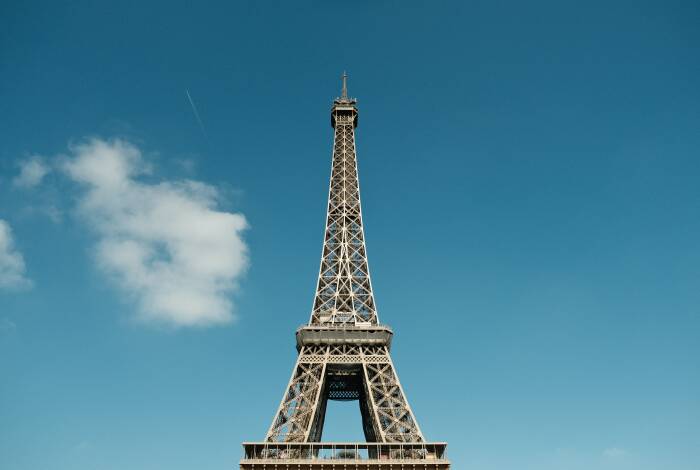
The summit awaits you with the Champagne Bar. This original bar offers not only a fascinating view of Paris but also caviar and homemade lemonades. A glass of the world-famous French champagne is certainly a crowning finale during the visit of the iconic Eiffel Tower.
The Eiffel Tower shines brightly
Since 1985, 20,000 lamps connected by 40km (131,23 ft) of power cables have made the Eiffel Tower shine in all its glory. After dark, the Eiffel Tower sparkles every full hour for five minutes. The last light show takes place at 11:00 pm. Due to energy-saving measures, the lighting is now turned off at 11:45 pm - earlier than in previous decades.
High visitor traffic
The Eiffel Tower is as impressive as it is popular - millions of tourists visit this attraction every year. The tower is thus one of the most visited landmarks in the world. Depending on the temperatures, however, the rush of visitors varies. In contrast to the winter months, the number of visitors in the summer is very high. The time between 9 am and 11 am is usually less crowded, as well as the evening between 8:00 pm and 10:30 pm. Possible waiting times can be followed live on the official website of the Eiffel Tower.
The green side of the Eiffel Tower
The magnificent gardens around the Eiffel Tower in the middle of the city invite visitors to relax and enjoy the view of the Eiffel Tower from below. They cover an area of 130,000m² (1,399,308.35 sq ft) and are divided into different areas, including the Champ-de-Mars, the Jardins du Trocadéro or the Esplanade des Invalides. Visitors can stroll through manicured lawns, blooming flower beds, walking paths, and fountains.
The history of the Eiffel Tower
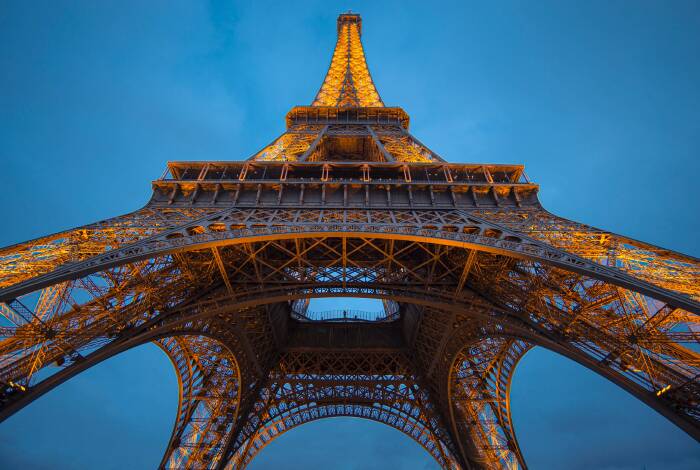
Originally, the Eiffel Tower was envisaged as the central attraction for the 'Exposition Universelle' in 1889. Over the decades, it has become increasingly popular. It has become increasingly popular over the decades and is closely associated with the French capital for Parisians, but also worldwide.
Chasing the record
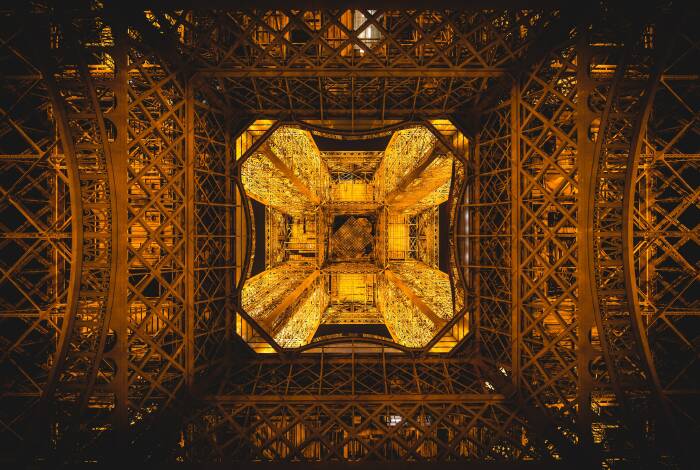
At the time the tower was conceived, the tallest building in the world was the Washington Monument at 169m (554.46 ft). In Paris, they were looking for a central object for the 1889 World's Fair, which was to be held on the occasion of the 100th anniversary of the French Revolution. In a competition, designs for a tower were sought that would be at least 300m (984.25 ft) high, have four sides, and be made of metal. Gustave Eiffel's concept (which was actually conceived by his employees Maurice Koechlin and Émile Nouguier) was considered practically feasible and was ultimately selected.
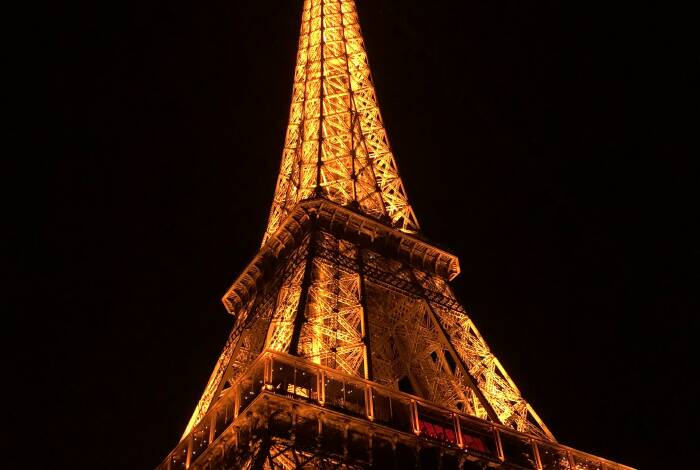
The Height of the Eiffel Tower
Since its opening, the actual structural height of the Eiffel Tower is 300.51m (985.93 ft). With the lantern and the flagpole, the tower reaches a total height of 312.27m (1024.51 ft) at its summit. There, over 120 antennas for the transmission of dozens of radio and television programs (used as a broadcasting tower) are located. The height of the antennas varied over the decades. The last change in the overall height occurred in March 2022: A new radio antenna has now increased the Eiffel Tower by another 6m (19.69 ft) to 330m (1082.68 ft).
A Later Crowd Favorite
Although initially rather unpopular among the population, the Eiffel Tower was built between January 1887 and March 1889 and made accessible to the public on May 6, 1889. Celebrities of the time, like Thomas Edison, Buffalo Bill and the Prince of Wales were among the first visitors to the building. The Eiffel Tower was originally intended to stand only until 1909, but by that time it was already being used for telecommunications and tourism. For 41 years, the tower remained the tallest man-made structure in the world, until it was surpassed by the Chrysler Building in 1930.
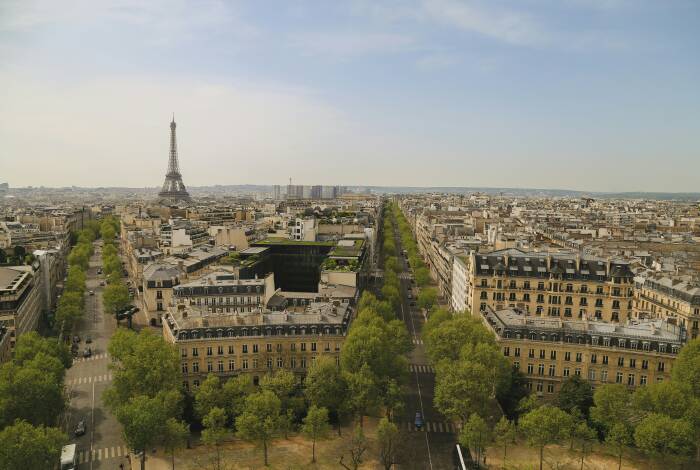
The Eiffel Tower - A Symbol of Tourism and Culture
In the world of architecture, there are few structures as iconic and universally recognized as the Eiffel Tower. As a landmark of Paris and one of the most famous symbols of France, the Eiffel Tower embodies not just the beauty of the City of Lights, but also a rich cultural history that attracts millions of people from around the world every year.
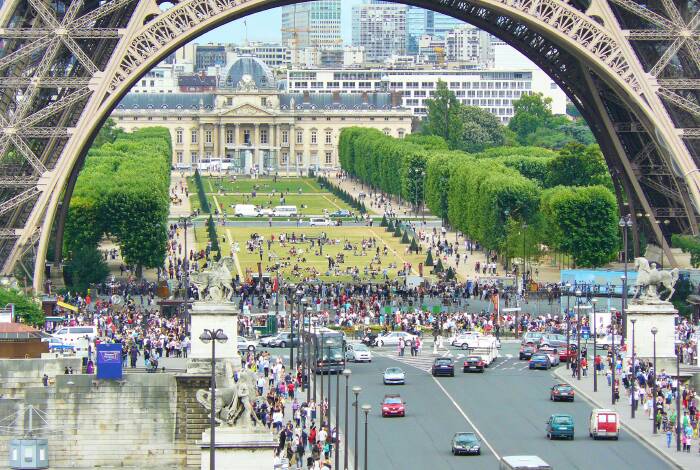
The source of inspiration
The Eiffel Tower was not only erected as a triumphant entry gate to the 1889 World's Fair but also as a manifestation of the technological progress and engineering skill of its time. When Gustave Eiffel brought his vision of the Eiffel Tower to life, he not only created an impressive steel and iron structure but also a source of inspiration for generations of architects and engineers.
However, the Eiffel Tower is more than just a technical masterpiece - it is a magnet for tourism and a focal point for cultural activities. Year after year, millions of visitors from all over the world flock to the foot of the tower to enjoy the breathtaking views from the observation decks, explore the rich history of the tower, and experience the romantic flair of Paris.
However, the Eiffel Tower is more than just a technical masterpiece - it is a magnet for tourism and a focal point for cultural activities. Year after year, millions of visitors from all over the world flock to the foot of the tower to enjoy the breathtaking views from the observation decks, explore the rich history of the tower, and experience the romantic flair of Paris.
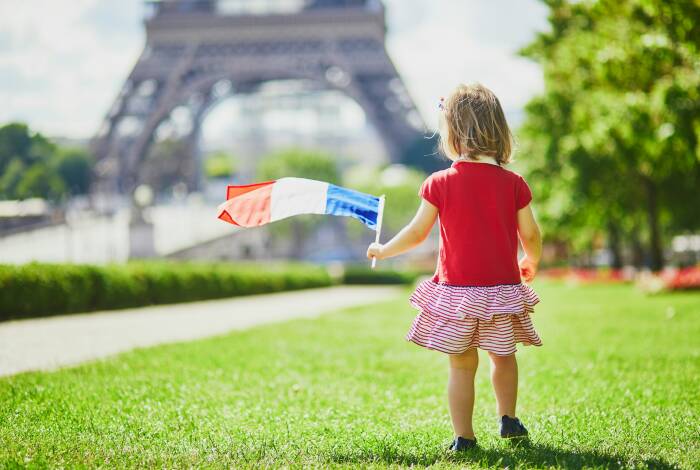
The symbolism of the Eiffel Tower
The Eiffel Tower has a profound impact on the cultural identity of France and serves as a symbol of love, art, and freedom that the city of Paris embodies. From its role in countless films, books, and paintings to its use as a stage for spectacular light shows and fireworks - the Eiffel Tower is more than just a structure. It is a symbol of the vibrancy and diversity of French culture.
TicketLens-Fact:
All medals of the Olympic Games and the Paraolympics 2024 contain 18 grams (0.63 oz) of iron of the Eiffel Tower both as a symbol and unique memory!
The Difficulties
While the Eiffel Tower is undoubtedly a touristical highlight in Paris, it also poses a challenge. Managing the daily influx of masses of visitors requires careful planning and good management to enhance the experience for everyone while preserving the structure and historical value of the tower.
Conclusion
In an era where the travel industry is rapidly evolving and the world is increasingly interconnected, the Eiffel Tower remains a timeless symbol of the significance of tourism and culture in the global context. The Eiffel Tower will continue to be a source of fascination and inspiration for travelers from all over the world, reminding us that true beauty lies not only in the structures we build but also in the stories and memories we share.
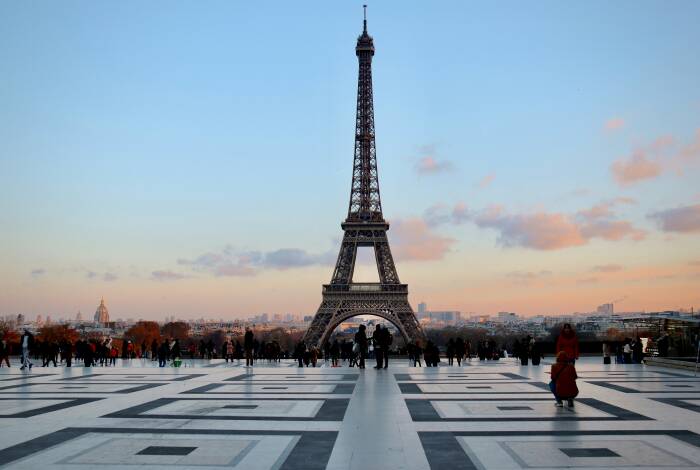
Quick facts about the Eiffel Tower
If you want to impress your fellow travelers with knowledge about this attraction during your visit of the Eiffel Tower, then it's best to read our collection of facts here. You will definitely impress them.
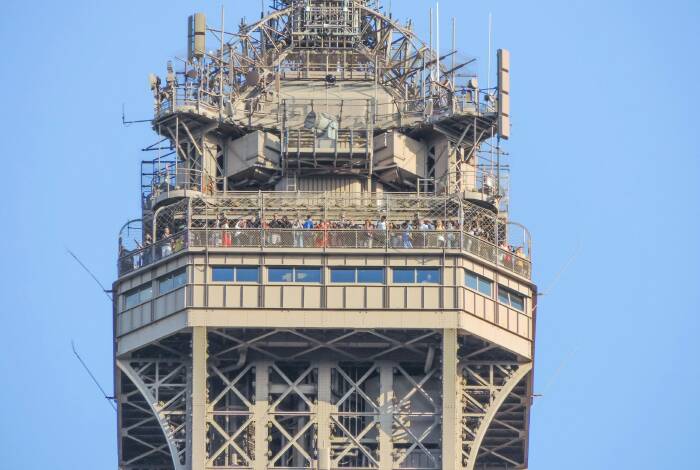
Temporary Structure
Originally, the Eiffel Tower was planned as a temporary structure that was to be dismantled after the World Fair of 1889. To keep the attraction, a radio antenna was erected on the Eiffel Tower. The plan worked, as the city's representatives recognized its use as a radio tower and decided not to demolish the Eiffel Tower.
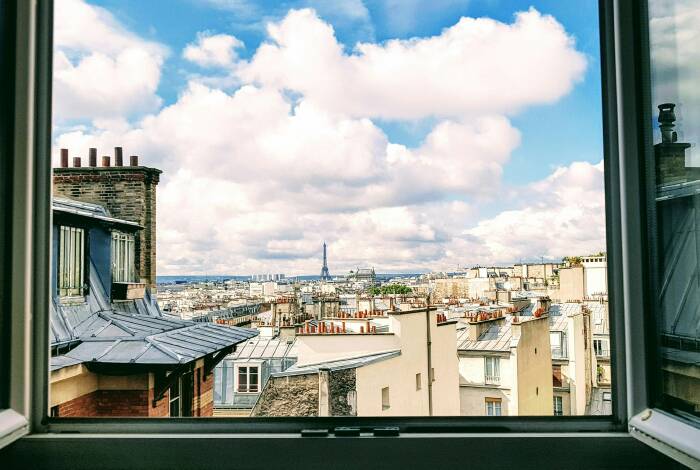
Critical Artists and Parisians
Today, the Eiffel Tower is considered a landmark of Paris. Previously, the iron lady was unfortunately not very popular. Intellectuals like Emile Zola referred to the Eiffel Tower as big perforated giraffe. The writer Guy de Maupassant even went so far as to dine daily on the first floor of the Eiffel Tower to avoid having to look at it.
The French wanted the tallest building
The tender for the building for the World Fair of 1889 demanded that the tower be at least 300m (984.25 ft) high. At the time, the Washington Monument at 169m (554,46 ft) was the tallest building, which was to be far surpassed.
Changing Heights
The Eiffel Tower was 300.51m (985.93 ft) high at its opening. Including the lantern and flagpole, it even reached a height of 312.27m (1024.51 ft). Over the years, additional antennas were added; thus, the tower varied in height again and again. An even longer antenna was last installed in March 2022 - the height of the Eiffel Tower today is therefore exactly 330m (1082.68 ft).
Growth in Heat
Due to the expansion of the metal in heat, the Eiffel Tower can grow up to 15cm (0.49 ft or 5.9 in) in height on a warm day.
Wind Resistance
The Eiffel Tower is constructed to withstand strong winds. Thanks to its flexible structure, it can even bend up to 12cm (0,065 ft or 4.72 in) when it blows hard.
Color Changes and Manual Labor in Painting
The Eiffel Tower has been repainted several times since its construction. It was originally red-brown, then yellow and red, before finally receiving its characteristic bronze color that it wears today. If you look closely, you can see that it is a bit darker on top than at the bottom. The Eiffel Tower is mostly painted by hand. It is repainted every seven years by 50 painters. On average, about 60 tons of paint are applied to the structure. In 2024, the Eiffel Tower received a golden coat of paint - as a symbol for the Olympic Games that year in Paris.
Hidden Apartment
Gustave Eiffel had a private apartment in the Eiffel Tower, which he used for guests and himself. This apartment is no longer accessible to the public today, but a reproduction of its furnishings can still be seen in the tower.
Role as a Research Laboratory
In the early years, the Eiffel Tower served as a laboratory for various scientific experiments, particularly for the exploration of radio technology.
The Eiffel Tower as Advertising Space
From July 4, 1925, Citroen used the Eiffel Tower as advertising space. The advertisement could still be seen from 40km (24,85 miles) away. At that time, 250,000 light bulbs formed the “Citroen” lettering. After 1934, the tower never served as advertising space again. An interesting fact is that the American pilot Charles Augustus Lindbergh Junior used the illuminated Eiffel Tower as a guide during the first solo non-stop transatlantic flight from New York to Paris.
72 Names
Gustave Eiffel had the names of 72 famous personalities engraved into the border of the tower's first floor. But how did he choose them, and why did he place them there?
The first floor of the tower is surrounded by a large continuous beam, which is interrupted by brackets carrying the balcony. In the spaces thus created, Gustave Eiffel had the names of scholars inscribed in golden, 60cm (1.97 ft) high uppercase letters under the patronage of science and progress as part of the celebrations for the 100th anniversary of the French Revolution.
However, these names were covered over the decades and were only made visible again during restoration measures. The names belong to scholars, scientists, and mathematicians who contributed to the successful construction of the tower and who were active as researchers.
The first floor of the tower is surrounded by a large continuous beam, which is interrupted by brackets carrying the balcony. In the spaces thus created, Gustave Eiffel had the names of scholars inscribed in golden, 60cm (1.97 ft) high uppercase letters under the patronage of science and progress as part of the celebrations for the 100th anniversary of the French Revolution.
However, these names were covered over the decades and were only made visible again during restoration measures. The names belong to scholars, scientists, and mathematicians who contributed to the successful construction of the tower and who were active as researchers.
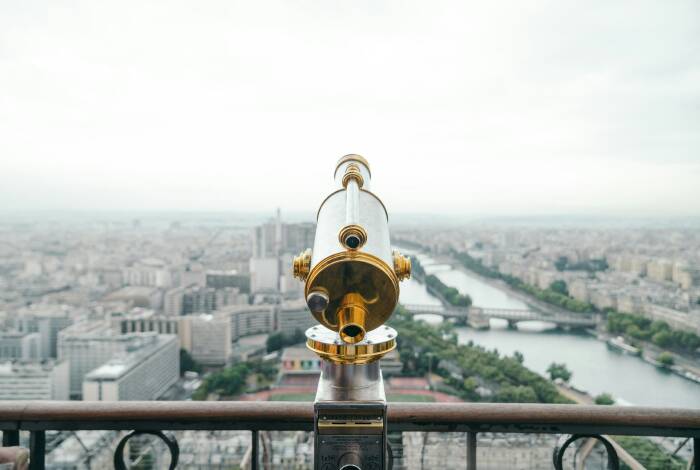
No photos of the Eiffel Tower at night allowed
After nightfall, a light show takes place every hour. It is officially forbidden to post photos or videos of the Eiffel Tower at night. The light show of the 20,000 LEDs is actually a work of art and protected by copyright. Therefore, taking and sharing photos is only okay if it is for personal memories, but they must not be used for commercial purposes under any circumstances.
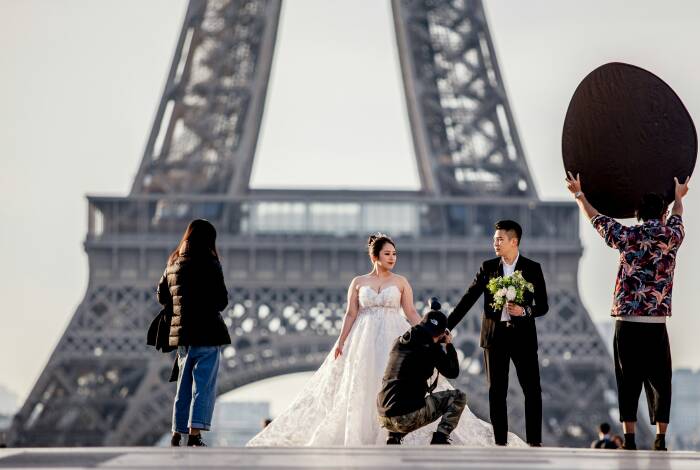
Will you marry me?
In the Jules Verne restaurant, an average of two marriage proposals are made every day. A marriage proposal might feel very special to you, but considering that about 700 couples get engaged at the Eiffel Tower every year, a proposal at the Eiffel Tower is somewhat basic.
View
From the very top you have a view of up to 80km (49,7 miles) in good weather conditions. This allows you to even see the outskirts of Paris, the landscape beyond the suburbs, the Charles de Gaulle Airport, or clearly the Parc des Princes (Paris Saint-Germain stadium) (Parc des Princes), the sporting home of Paris Saint-Germain football club.
Extreme Sports
Since its construction, the Eiffel Tower has fascinated extreme sports enthusiasts. Franz Reichelt, for example, jumped off the Eiffel Tower in 1912 with a homemade parachute. Unfortunately, he did not survive the jump. In 1991, a pilot, who remains unknown to this day, flew a stolen airplane through the Eiffel Tower and then returned the plane to another airfield. Climbers regularly scale the Eiffel Tower with their bare hands. Of course, Red Bull has also organised a sports event at the Eiffel Tower. Taïg Khris jumped from the first floor on inline skates and thereby secured a record in the Guinness Book of Records.
Frequently Asked Questions
Is the Eiffel Tower accessible for people with disabilities?
This attraction is accessible. Please note that, for safety reasons, wheelchair users can only visit the first and second floor.
Read more.Can you bring food?
Small snacks and drinks may be taken onto the Eiffel Tower, although there are no picnic areas on the tower itself. Please note that neither glass bottles nor beverage cans are allowed on the tower.
Read more.Are there dining options on the Eiffel Tower?
Aside from small food stands, the Eiffel Tower also offers exquisite restaurants on the first and second floor. These include the Jules Verne, which entices with creative French cuisine, and the Persian restaurant Madame Brasserie. Reservations must be made in advance at the restaurants.
Read more.Is it allowed to carry bags and backpacks during the visit?
Small luggage items are allowed on the tour. Due to increased security measures, carrying suitcases and travel bags is not permitted. Also, only foldable strollers can be brought. Please note that there are no luggage storage facilities.
Read more.What do I need to bear in mind when booking tickets?
Tickets purchased online are valid only on the specified day. The issued ticket cannot be returned, refunded, exchanged, or adjusted. When booking tickets, also check the names provided and, if necessary, add a free infant ticket.
Read more.Is there a souvenir shop?
there is a souvenir shop on the second floor of the Eiffel Tower.
Read more.Are dogs allowed on the Eiffel Tower?
No, animals are not allowed in the building. The only exception is for certified assistance dogs.
Read more.Is it allowed to take photos and videos of the Eiffel Tower?
Photos and videos of the Eiffel Tower can be taken. Commercial use is also permitted, but must be specifically reviewed in advance before use. Since the light show was developed by Pierre Bideau in 1985, photographing during the show is not generally allowed. For private use and publishing of images from the show, a copyright notice with "Copyright Tour Eiffel – Illuminations Pierre Bideau" should be set.
Read more.Paris's highest observation decks
Photo
Building
Total height
Height of observation deck
Open since
Paris
Eiffel TowerParis | France
324m#1 in Paris#1 in France#43 worldwide
276m#1 in Paris#1 in France#36 worldwide
1889
Tour MontparnasseParis | France
210m#2 in Paris#2 in France#78 worldwide
210m#2 in France#65 worldwide
1973
Grande ArcheParis | France
111m#3 in Paris#3 in France#89 worldwide
111m#3 in France#84 worldwide
1989
worldwide
Empire State BuildingNew York | USA
443m#3 in USA#17 worldwide
373m#3 in USA#14 worldwide
1931
Eiffel Tower is number 1 in Paris and number 36 on the worldwide list of the tallest buildings with an observation deck.
General information
opening hours
From August 24 through 29, 2026, the tower is open daily from 9:00 am to 12 midnight, with the last ascent at 10:45 pm. Hours beyond this period are published date by date and may change without notice. Summit access may be restricted in severe weather or at peak times, and public areas may close for safety.
address
Eiffel Tower
Champ de Mars, 5 Avenue Anatole France
75007 Paris
Champ de Mars, 5 Avenue Anatole France
75007 Paris
website
Official site: https://toureiffel.paris
tickets
2026 standard admission (valid from January 12):
- 2nd floor – elevator: adults €23.50, ages 12–24 €11.80, ages 4–11 €6.00.
- Summit – elevator: adults €36.70, ages 12–24 €18.40, ages 4–11 €9.20.
- 2nd floor – stairs: adults €14.80, ages 12–24 €7.40, ages 4–11 €3.80.
- Summit – stairs + elevator: adults €28.00, ages 12–24 €14.00, ages 4–11 €7.00.
Visitors with disabilities and one companion pay the listed child rate with valid proof. Children under 4 enter free but still need a ticket. Online tickets are issued for a reserved date and time; same-day online and on-site tickets are subject to availability. From September 29, 2026, stair tickets must be reserved in advance. Rates may change.
- 2nd floor – elevator: adults €23.50, ages 12–24 €11.80, ages 4–11 €6.00.
- Summit – elevator: adults €36.70, ages 12–24 €18.40, ages 4–11 €9.20.
- 2nd floor – stairs: adults €14.80, ages 12–24 €7.40, ages 4–11 €3.80.
- Summit – stairs + elevator: adults €28.00, ages 12–24 €14.00, ages 4–11 €7.00.
Visitors with disabilities and one companion pay the listed child rate with valid proof. Children under 4 enter free but still need a ticket. Online tickets are issued for a reserved date and time; same-day online and on-site tickets are subject to availability. From September 29, 2026, stair tickets must be reserved in advance. Rates may change.
how to get there
The Eiffel Tower can be reached via Metro line 9 (Trocadéro station, 15 minutes walk) Metro line 6 (Bir-Hakeim station, 10 minutes walk) and Metro line 8 (Ecole Militaire station, 15 minutes walk) or RER line C (Champ de Mars station, 7 minutes walk). The following bus lines take you to the Eiffel Tower: 42,72 and 82 (Tour Eiffel station, 5 to 7 minutes walk) as well as line 69 and 87 (Champ de Mars station, 6 minutes walk).
Nearby car parks are 'Parking Pullmann Tour Eiffel' (5 minutes walk), '443 Avenue Joseph Bouvard' (6 minutes walk) or '2 Place Joffre' (12 minutes walk).
Nearby car parks are 'Parking Pullmann Tour Eiffel' (5 minutes walk), '443 Avenue Joseph Bouvard' (6 minutes walk) or '2 Place Joffre' (12 minutes walk).

Written byJessica DonevJessica is the definition of Jack of all trades. When she wants to do something, she just does it. That's why Jessica is an event manager, professional dancer, trainer, content creator, speaker / presenter in training and much more. Having traveled the world a lot, she knows what's important when traveling and shares it with you here on TicketLens.
How useful was this page?
Average rating 4.6 / 5. Vote count: 270.
Compare prices for more top sights in Paris:
Popular attractions
Acropolis ticketsRobben Island ticketsPanoptikum ticketsWieliczka Salt Mine ticketsThe Shard ticketsVilla di Castello ticketsYonghegong Lama Temple ticketsMARKK - Museum of Ethnology ticketsMuseum Island ticketsCalifornia's Great America ticketsOne World Trade Center ticketsEiffel Tower ticketsBurj Khalifa ticketsMilan Cathedral ticketsGuinness Storehouse ticketsLast Supper - Santa Maria delle Grazie ticketsMoulin Rouge ticketsGardens by the Bay ticketsStratosphere Tower ticketsDisneyland Paris ticketsDohány Street Synagogue ticketsHarry Potter: Warner Bros Studios tickets
Language
English
Currency© 2020-2026 TicketLens GmbH. All rights reserved. Made with love in Vienna.