Metropolitan Museum of Art
Tickets
Compare admission tickets and check which areas and extras are included in your chosen option.Guided Tours
Explore with a guide or choose a package with a guided city tour. Check where the guided part takes place and whether admission is included.More Tickets & Tours
Explore more experiences related to this attraction and check what each offer includes.Current exhibitions
Independence and Identity: Selections from the Department of Drawings and Prints
This rotating works-on-paper presentation brings together images of autonomy, artistic freedom, revolution, monuments, and labor from Europe and the Americas.
Creatures of Myth and Imagination: Europe and the Americas
More than 50 works from Europe and the ancient Americas explore hybrid beings, showing how fantastical creatures helped people imagine power, transformation, and the unknown.
Costume Art
The Costume Institute's spring exhibition pairs garments with artworks across The Met to examine how the dressed body has been imagined from prehistory to the present.
Celebrating the Year of the Horse
Works in ceramics, glass, jade, metal, and prints explore the horse's symbolic power and its role in Chinese society, belief, transport, and warfare.
Flip Sides: Seeing Korean Art Anew
About 50 works, many shown for the first time, reveal the reverse, interior, and hidden construction of Korean objects in metal, wood, ceramics, textiles, and lacquer.
The Genesis Facade Commission: Liu Wei
Liu Wei will create four large-scale facade sculptures that use urban fragments, historical references, and bodily forms to reflect on rupture and resistance.
Household Gods: Hindu Devotional Prints, 1860-1930
Around 120 chromolithographs, paintings, and portable shrines trace how inexpensive printed images brought Hindu devotional practice into homes across India.
The Infinite Artistry of Japanese Ceramics
Across roughly 350 works, this exhibition surveys Japanese ceramics from early ritual figures to contemporary practice, placing vessels in dialogue with related art forms.
A King's Carpet: Louis XIV and the Savonnerie
Centered on The Met's Savonnerie carpets, this exhibition traces Louis XIV's vast Louvre commission, its demanding production, and the later dispersal of these Baroque textiles.
Krasner and Pollock: Past Continuous
More than 120 works reconsider Lee Krasner and Jackson Pollock side by side, tracing their intertwined careers and the different paths they took through Abstract Expressionism.
4 tips for visiting the Metropolitan Museum of Art
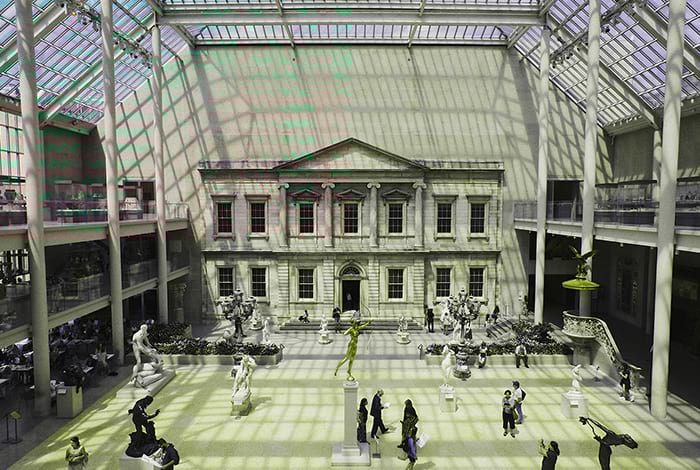 Photo: Robert Bye, Art gallery with glass ceilings - Unsplash
 Photo: Lydia Liu, View of Central Park from the Met’s Rooftop - Creative Commons Attribution 2.0
Frequently Asked Questions
What’s there to see in the Met?
So what’s the deal with the Met Breuer and the Met Cloisters?
How long should I plan for my visit?
Can I sketch inside the Met?
General information
opening hours
tickets
address
1000 5th Ave
New York, NY 10028