Palazzo Vecchio
TicketLens lets you:
Search multiple websites at onceand find the best offers.
Find tickets, last minuteon many sites, with one search.
Book at the lowest price!Save time & money by comparing rates.
The Palazzo Vecchio (‘Old Palace’) was originally called the Palazzo della Signoria after the medieval government of Florence who built and used it. Today most of the building is a museum. Visitors can see the stunning frescoes and ceilings in the Salone dei Cinquecento and the Studiolo of Francesco I. You can also see Machiavelli’s office from the time when he was Secretary of the Republic, and a replica of Michelangelo’s David standing where the original once stood. Waiting times can be long in peak periods, so book tickets in advance to skip the lines!
Select a date to find available tickets, tours & activities:
Tickets
Book your tickets in advance to skip the lines on the day of your visit.Palazzo Vecchio: Skip-the-Line Entry and Secret Passage Tour
4.7(1314)
getyourguide.com
Go to offer
Palazzo Vecchio Skip-the-Line Tickets
4.2(5636)
headout.com
Go to offer
Palazzo Vecchio Skip-the-Line Guided Tour
4.3(2241)
headout.com
Go to offer
Florence: Palazzo Vecchio Entrance Ticket & Audioguide
4.4(5384)
Go to offer
See all Tickets
Guided Tours
Learn more about art & architecture of the Palazzo Vecchio.Florence: Palazzo Vecchio Guided Tour
4.8(1414)
Go to offer
Palazzo Vecchio: Skip-the-Line Entry and Secret Passage Tour
4.7(1314)
getyourguide.com
Go to offer
Palazzo Vecchio Skip-the-Line Guided Tour
4.3(2241)
headout.com
Go to offer
Palazzo Vecchio, Arnolfo Tower, Museum: Entry Ticket + Audio Guide
4.5(293)
tiqets.com
Go to offer
See all Guided Tours
More Tickets & Tours
Browse even more products that include a trip to the Palazzo Vecchio.Florence: Palazzo Vecchio Museum
4.6(76)
Go to offer
Florence: Palazzo Vecchio Panoramic View with Audio Guide
viator.com
Go to offer
4 tips for visiting the Palazzo Vecchio
 Torre di Arnolfo
1
Get an Awesome View from the Tower
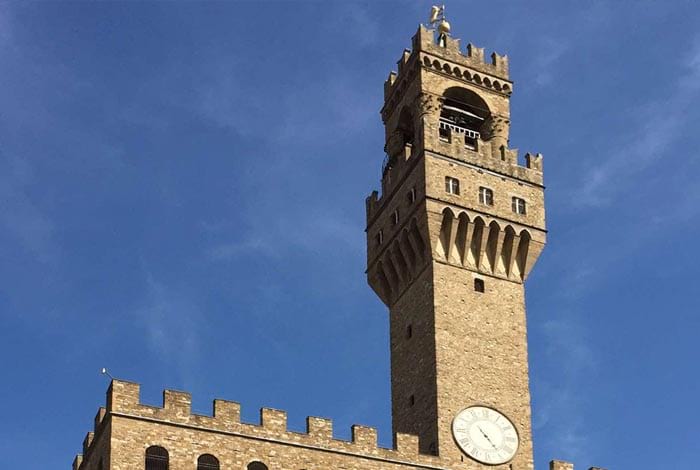
The Torre di Arnolfo is 95 m (311 ft) tall and is one of the most recognizable landmarks in Florence. The tower contains 233 steps and is a pretty challenging climb so it closes if it starts to rain. There’s often a line to access the tower, so consider making it one of the first stops on your tour of the palazzo.
 Firenzecard
2
Go for the Firenzecard
If you know you want to visit multiple museums or other sites in Florence, look into the Firenzecard. It offers you tickets for entry, any special exhibitions, and skip-the-line access more than 70 different attractions included. Combine your trip to the Palazzo Vecchio with the Uffizi Gallery, Medici Chapels, and several other museums, galleries, gardens, and religious sites, or go for the Firenzecard+ to get a free public transport ticket as well.
3
Take a Guided Tour to Discover Secret Areas
The Palazzo Vecchio offers several different guided tours, but the one that is especially worth taking is the Secret Passages tour! In addition to being taken around some of the most significant rooms, you’ll also be taken into several rooms and staircases used by the Medicis to move around the palace unseen. It takes 75 minutes. Guided visits and activities cost €8 for non-residents of the Florence metropolitan area or €4 for residents, plus museum admission.
4
Visit the Roman Ruins
In 2014, the Italian Archaeological Cooperative formally announced that they had discovered a Roman amphitheater under the foundations of the Palazzo Vecchio, dating back to between 30 and 15 BCE. The archaeological route is temporarily closed to visitors, so confirm that it has reopened before planning your visit.
Palazzo Vecchio: Power Symbol of the Medici
Palazzo Vecchio housed the city parliament and administration of Florence and still serves as the city's town hall. The oldest part of the building was built from 1299 on the ruins of the palace of the Uberti family.
History of Palazzo Vecchio
In 1299 the Florentines decided to build a palace to house the governmental apparatus of the Republic and to have a representative building of the power of the Republic and the city. Arnolfo di Cambio, the architect of the Florentine Cathedral and the Church of Santa Croce, began construction on the ruins of the Palazzo dei Fanti and the Palace of the Executives in Piazza della Signoria. As with all great buildings of the time, it took several generations to complete the work. During the 16th century, Cosimo I de' Medici arranged for the restructuring and decoration of the building to make it his residence. Thus, the building came to its current appearance and became Palazzo Ducale (Ducal Palace, refering to the term Ducal, relating to the Duke). Later Cosimo I de' Medici moved his residence to Palazzo Pitti, so Palazzo Ducale was renamed Palazzo Vecchio.
The palazzo was intended not only to be easily defensible, but also to reflect the prosperity and growing influence of the city of Florence. The original clock tower was only later replaced by a taller one, today's Torre di Arnolfo.
The provisional Italian government of 1865 to 1871 also used the building for offices, but since 1872 the mayor of Florence has sat here and the city council has met. The Museum in the Palazzo Vecchio shows historical and art.
Sights to see in Palazzo Vecchio
Salone dei Cinquecento
In the Palazzo there are several particularly outstanding rooms: the Salone dei Cinquecento (Hall of the Five Hundred) was the meeting room of the Grand Council of the Republic of Florence, following that of the High Council of the Republic of Venice. When Cosimo I de' Medici moved into the palazzo, he used the room for public ceremonies. During the remodeling, much of the art originally housed here was lost, including works by Leonardo da Vinci and Michelangelo. Da Vinci's work was reportedly hidden behind a hollow wall, but has not been found to this day. Frescoes depicting Florence's victories over Siena and Pisa can also still be seen here today.
Sala degli Elementi
On the second floor a highlight is the Sala degli Elementi: five rooms that served as Cosimo I's living quarters and are decorated on various themes from nature and mythology. The chambers of Cosimo's wife, Eleonora di Toledo were equally luxurious with friezes, wallpaper and painted ceilings.
Courtyard
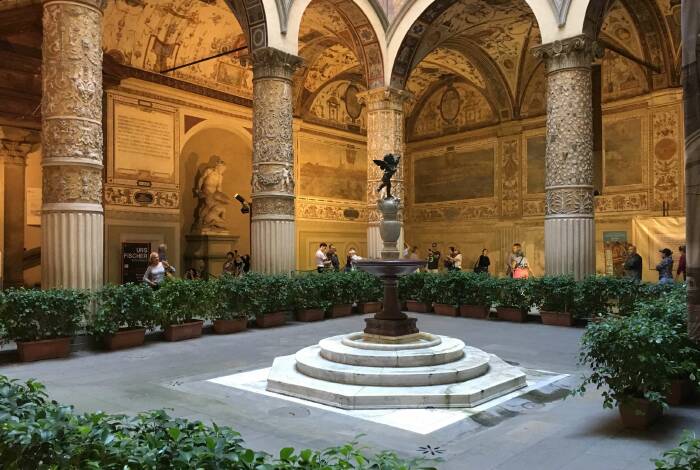
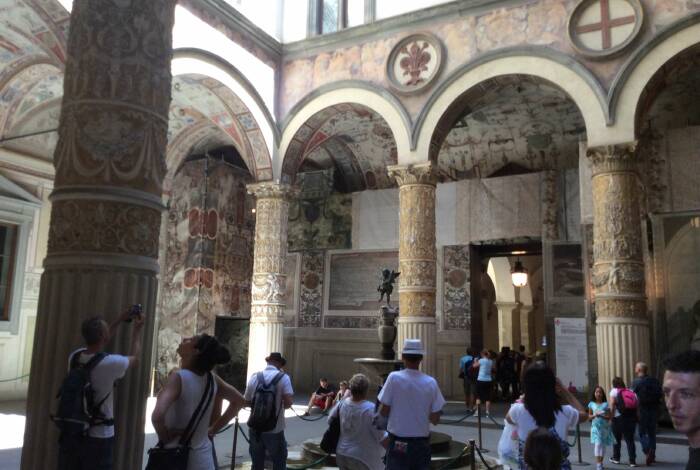
The courtyard, designed by Michelozzo, is decorated with ornate and gilded columns, frescoes and sculptures. The grotesque mixture of human, animal and plant motives was in fashion during the Renaissance.
Sala delle Carte Geografiche
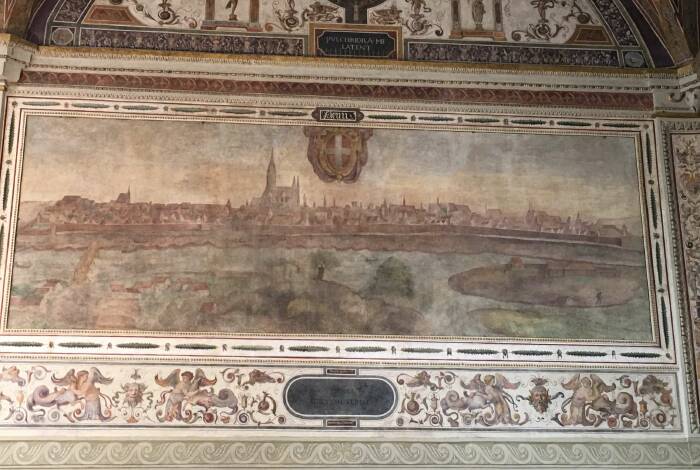
The Sala delle Carte Geografiche shows the world as it was known in the 16th century and housed the Medici's most unusual treasures. The unique interior design by Dionigi di Matteo Nigetti includes wall cabinets with maps on the doors. A large 16th-century globe stands in the center of the room; a matching celestial globe was never completed.
Corridoio vasariano
The Corridoio Vasariano is an elevated, covered corridor in Florence that connects Palazzo Vecchio with Palazzo Pitti and leads through the Uffizi Gallery. This historic corridor was built in the 16th century by Giorgio Vasari.
The statue of David in front of Palazzo Vecchio is a copy, since the original David stood in this place between 1504 and 1873, but it suffered damage due to environmental factors and was moved to its current location in the Galleria dell' Accademia. Since 1910 the replica stands in front of the Palazzo della Signoria.
Guided tours of Palazzo Vecchio
Tours are offered with focus on different aspects.
Main Topics
The normal tour is offered four times daily except Thursdays (10:30 and 12:00 only). The Secret Passages tour (excluding the Vasari Corridor) is also offered four times daily except on Thursdays (10:00 and 11:30 am only). Available languages are Italian, English, French and Spanish.
Another tour is called Secrets of Inferno and is devoted to the specific locations of Dan Brown's novel Inferno daily except Thursdays at 2:00 p.m.
The Invitation to the Court tour takes you through the palace before introducing you to actors playing the duke Cosimo I de' Medici and the Duchess Eleonora di Toledo and asking questions about life at court. The dialogue with the character will make the visitor understand the differences between today’s society and the civilization of the Sixteenth century in Florence, to think over today’s codes and habits and give back to the decoration of the Medici family’s Palace a defined historical and political context.
A tour of the work of architect and artist Giorgio Vasari is offered every day except Thursday at 15:30 in Italian and English. This tour is not available in July and August. All tours last 75 minutes and cost an additional €5.
Frequently Asked Questions
Will my children enjoy a visit to the Palazzo Vecchio?
Yes! The Palazzo Vecchio has a handful of guided tours which are child-friendly, plus story-telling sessions and other activities. Children between the ages of four and seven will enjoy the Story of the Turtle and the Snail, which explains one of Cosimo I de’ Medici’s favorite mottos: Festina Lente, or ‘make haste slowly’. After listening to the fairytale, children will be led on a ‘turtle chase’ around the rooms of the palazzo. Children aged 8 and over can enjoy the opportunity to try painting a fresco of their own! The fresco painting workshop takes place on Saturdays and Sundays at 10 am or 3 pm and guidance is provided in Italian, English, or French. Families can also borrow a special kit from the information desk. It includes a map and ideas for making the museum come alive for children aged six and over.
Read more.What other sights are in the immediate vicinity of Palazzo Vecchio?
Very close to Palazzo Vecchio there are other monuments worth visiting: The Loggia dei Lanzi is a small outdoor museum next to Palazzo Vecchio. Here you can see various works such as the Rape of the Sabine Women or Perseus with the head of Medusa. The Uffizi Gallery, built in 1560 by Giorgio Vasari by the order of Cosimo I de' Medici, is also located in the vicinity. On the other side of Palazzo Vecchio is the Fountain of Neptune, called by the Florentines il biancone. Next to it stands the equestrian statue of Cosimo I, sculpted by Giambologna in 1594.
Read more.General information
opening hours
Museum: Monday, Tuesday, Wednesday, Friday, Saturday, and Sunday from 9 am to 7 pm; Thursday from 9 am to 2 pm. Torre di Arnolfo: the same days from 9 am to 5 pm; Thursday from 9 am to 2 pm. Ticket sales end one hour before closing. The tower closes in rain and during level-3 heat alerts, with access then limited to the battlements. Institutional events can cause short-notice partial or full museum-route closures, so check current visitor notices.
address
Palazzo Vecchio
Piazza della Signoria
50122 Florence
Italy
Piazza della Signoria
50122 Florence
Italy
website
Official site: https://musefirenze.it/en/musei/museo-di-palazzo-vecchio/
tickets
Standard museum admission costs €18; reduced admission is €12 for ages 18–25 and university students; ages 0–17 enter free. Torre di Arnolfo: standard €20, reduced €13. Paid online tickets add a €1 presale fee. Reserve a timed entry even for free admission; tower visits require advance booking and arrival 15 minutes early. For the tower, visitors under 18 need an accompanying adult, and children under 6 cannot enter.
how to get there
You can walk to the Palazzo Vecchio from Florence’s main train station, Santa Maria Novella, in less than 20 minutes. Alternatively, you can take bus number C2 to stops nearby. The closest car park is at Santa Maria Novella train station.
How useful was this page?
Average rating 4.7 / 5. Vote count: 3.
Compare prices for more top sights in Florence:
Palazzo del Bargello20 tickets & guided tours
Popular attractions
Burj Khalifa ticketsDoge's Palace ticketsMadame Tussauds London ticketsBioparc València ticketsDisneyland ticketsHMS Belfast ticketsDDR Museum ticketsSainte-Chapelle ticketsOne World Trade Center ticketsEiffel Tower ticketsMilan Cathedral ticketsGuinness Storehouse ticketsLast Supper - Santa Maria delle Grazie ticketsMoulin Rouge ticketsGardens by the Bay ticketsStratosphere Tower ticketsDisneyland Paris ticketsDohány Street Synagogue ticketsHarry Potter: Warner Bros Studios tickets
Language
English
Currency© 2020-2026 TicketLens GmbH. All rights reserved. Made with love in Vienna.