Alcázar de los Reyes Cristianos
TicketLens lets you:
Search multiple websites at onceand find the best offers.
Find tickets, last minuteon many sites, with one search.
Book at the lowest price!Save time & money by comparing rates.
The Alcázar de los Reyes Cristianos (Spanish for ‘Castle of the Christian Monarchs’, also known as the Alcázar of Córdoba) is one of the most significant historic buildings in the city of Córdoba. Home to both Moorish and Christian monarchs, the Alcázar also served as the headquarters of the Spanish Inquisition in Córdoba for several centuries. The fortress itself is a beautiful example of Mudéjar architecture, and is surrounded by even more stunning gardens.
Select a date to find available tickets, tours & activities:
Guided Tours
Explore with a guide or choose a package with a guided city tour. Check where the guided part takes place and whether admission is included.Alcazar of Cordoba Entry Ticket and Guided Tour
4.0(392)
getyourguide.com
Go to offer
Córdoba: Mosque-Cathedral, Jewish Quarter and Alcázar Tour
4.6(1914)
getyourguide.com
Go to offer
Cordoba: Alcazar Guided Tour and Skip-the-Line Ticket
4.1(1880)
getyourguide.com
Go to offer
Córdoba: Mosque, Jewish Quarter and Alcázar 3-Hour Tour
4.8(493)
getyourguide.com
Go to offer
See all Guided Tours
4 tips for visiting the Alcázar de los Reyes Cristianos
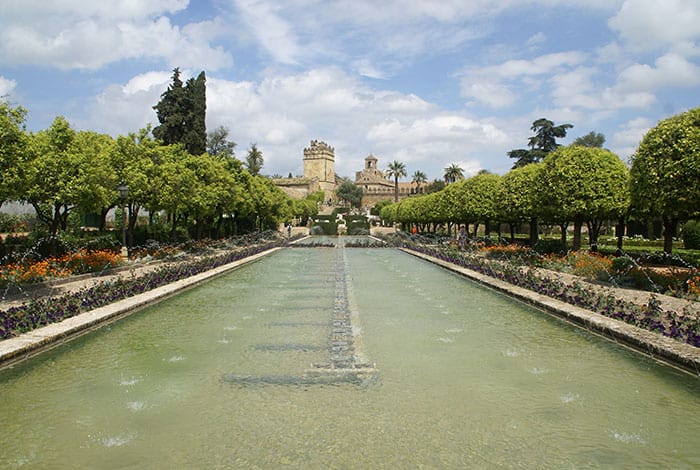 Gardens of the Alcázar de los Reyes Cristianos | Photo: David Baron CC BY-SA
1
Only the gardens are currently open during restoration, so make them the focus of your visit. Take the King’s Walk and see if you can spot orange, lemon, and palm trees or discover all the calming water features.
 Alcázar de los Reyes Cristianos | Photo: Avinash Bhat CC BY-SA 2.0
2
The gardens of the Alcázar contain plenty of steps and uneven surfaces, so make sure to wear comfortable shoes for walking. In summer, prepare for the extreme heat by packing sunscreen and water.
3
Take a guided tour! There aren’t many signs providing information in the gardens, so a guide can point out the most significant sites. If you would rather visit by yourself, do some research before you go.
4
Try to visit the Alcázar in the morning, especially during the summer, as it can be both busy and hot during the late morning and early afternoon.
Frequently Asked Questions
What is the Alcázar de los Reyes Cristianos?
Originally a Visigoth fortress, then rebuilt by the Umayyad Caliphate, where Abd ar-Rahman I established the independent Caliphate of Córdoba which used the Alcázar as their palace until 1236. During this period the city flourished, and the palace was renowned for its baths, gardens, and large library. The current structure began to take form in 1328 when it was rebuilt by Alfonso XI of Castile. The building was then used by Isabella and Ferdinand as their military headquarters during their campaign against the Nasrid dynasty in Granada, and it was there that they met Christopher Columbus before he undertook his first voyage to America. Isabelle and Ferdinand also gave the Alcázar to the Spanish Inquisition, and it was one of the longest-running permanent tribunals of the Inquisition in Spain. In more recent history, the building was used as a garrison by Napoleon in 1810 before becoming a prison. It’s been a national monument and tourist attraction since the 1950s.
Read more.What was the Spanish Inquisition?
The Spanish Inquisition was one of the institutions founded by Ferdinand II of Aragon and Isabella I of Castile in order to enforce religious orthodoxy in their kingdoms, replacing the existing Papal Inquisition, which was directly run by Rome. The kingdoms in question had laws in place requiring Jewish and Muslim residents to convert to Catholicism, and the Inquisition played a part in policing these conversions. Individuals accused of heresy were convicted of false conversion, of being Christian heretics, or of committing some other crime against Roman Catholic doctrine, and were often subjected to torture. Córdoba was the site of one of the earliest permanent tribunals of the Spanish Inquisition, founded in 1482, and the Tower of the Inquisition in the Alcázar housed the archives of the Tribunal of the Holy Inquisition for several centuries. Between 1540 and 1700 there reportedly 883 trials and 8 executions in Cordóba, though the real numbers are considered to be at least 5000 trials and 27 executions. At least 26 people were also executed ‘in effigy’. During the autos da fé between 1701 and 1746, it’s estimated that 161 people in total were executed (in person or in effigy) and ‘penanced’. But don’t think that being burned in effigy was the soft punishment - common reasons victims were executed in effigy is because they’d escaped into exile abroad or had already died while imprisoned. The Spanish Inquisition was eventually abolished in 1834 after a century of declining influence and power, and today its era is usually remembered as a time of extreme religious intolerance and persecution.
Read more.What’s there to see inside the buildings?
The buildings are currently closed for restoration, so the present visit is limited to the gardens. Interior highlights include the Salón de los Mosaicos, with artworks discovered in the 1950s in Plaza de la Corredera, the reception-hall mosaics, and the 1328 Royal Baths of Doña Leonor. After the restoration, check which rooms and tower areas have reopened before planning around them.
Read more.How long should I plan for a visit?
While restoration limits the visit to the gardens, plan at least an hour, or up to two hours with a guided tour. Check the visitable areas again once the restoration is complete.
Read more.Is a trip suitable for children?
This depends on your children's interests since the attraction is not specifically designed with features to appeal to them. Some kids might enjoy imagining themselves living in the Alcázar, or running through the gardens, but others may not find it so engaging.
Read more.General information
opening hours
Only the gardens are currently open while the rest of the monument is under restoration. In summer (June 16–September 15), the gardens open Tuesday through Sunday at 8:15 am and close in the early afternoon. The general winter schedule (September 16–June 15) is Tuesday through Friday from 8:15 am to 8:15 pm, Saturday from 9:30 am to 5:30 pm, and Sundays and public holidays from 8:15 am to 2:15 pm. Closed Mondays, January 1, and December 25; on December 24 and 31, closing is at 2:15 pm. Check the date-specific calendar before visiting while restoration limits visits to the gardens.
address
Alcázar de los Reyes Cristianos
Campo Santo de los Mártires, s/n
14004 Córdoba
Campo Santo de los Mártires, s/n
14004 Córdoba
website
Official site: https://alcazardelosreyescristianos.cordoba.es
tickets
The 2026 fee schedule lists standard admission to the Alcázar at €7; during restoration, however, only the gardens are visitable, and no standalone price for this garden-only visit is currently displayed. Current bundles are: Alcázar Gardens + Baños del Alcázar Califal, €7.16 online or €7.50 at the ticket office; Córdoba Monuments Pass, €13.91 online or €15 at the ticket office. For the monuments pass, the reduced online ticket is €7.16 for eligible visitors; €0 tickets are available to visitors under 17, registered unemployed visitors, visitors with a documented disability of at least 33% plus one necessary companion, eligible teachers and guides, and Córdoba residents. Admission is also free during the final two opening hours on non-holiday Thursdays and on designated free-entry dates; a €0 ticket may still be required.
how to get there
The Alcázar de los Reyes Cristianos can be easily reached via bus numbers 3 and 12 to Mártires or numbers 2, 6, or 9 to Puerta Sevilla D.C.. The Alcázar is within walking distance of the Belén Tower and other popular sites in Córdoba. Parking is available for a fee at private car parks nearby.
How useful was this page?
Average rating 4 / 5. Vote count: 9.
Compare prices for more top sights in Córdoba:
Patios of Córdoba19 tickets & guided tours
Medina Azahara14 tickets & guided tours
Royal Stables of Córdoba1 tickets & guided tours
Palacio de Viana0 tickets & guided tours
Córdoba Synagogue3 tickets & guided tours
Casa de Sefarad0 tickets & guided tours
Hammam Al Ándalus Córdoba1 tickets & guided tours
Popular attractions
Guinness Storehouse ticketsBelém Tower ticketsLandmannalaugar ticketsWawel Castle ticketsStratosphere Tower ticketsEtihad Towers Observation Deck ticketsLondon Bridge ticketsNew York Aquarium ticketsPère Lachaise Cemetery ticketsOne World Trade Center ticketsEiffel Tower ticketsBurj Khalifa ticketsMilan Cathedral ticketsLast Supper - Santa Maria delle Grazie ticketsMoulin Rouge ticketsGardens by the Bay ticketsDisneyland Paris ticketsDohány Street Synagogue ticketsHarry Potter: Warner Bros Studios tickets
Language
English
Currency© 2020-2026 TicketLens GmbH. All rights reserved. Made with love in Vienna.